

Every call center lives and dies by its ability to pick up the phone quickly. Service level is the yardstick we use to measure that speed—it tells us the percentage of calls answered within a chosen timeframe, usually 80/20: that is, answering 80% of calls in 20 seconds.
Imagine walking into a coffee shop where the barista greets you within a minute of your order. In a call center, service level works the same way. It’s a clear promise: your team agrees to answer the majority of calls within a set window.
Keeping that promise has ripple effects. The right staffing plan prevents long queues, softens customer frustration, and gives leaders a concrete goal to rally around.
The so-called 80/20 rule isn’t about cutting corners—it’s about balance. It accepts that some calls will take longer but ensures the lion’s share get handled fast.

On a typical call center floor, agents plug into headsets as supervisors watch real-time dashboards. Those screens highlight service level alongside other key stats, guiding quick decisions on breaks or ramping up resources.
More than just a number, service level sets the tone for your entire operation. It shapes:
The table below offers a bird’s-eye view of how these metrics stack up across the industry.
Service Level Metrics at a Glance
| Definition | Common Threshold | Typical Target | Average Performance |
|---|---|---|---|
| Percentage of inbound calls answered within a set time window | 80/20 | 80% of calls in 20 seconds | 70%–80% |
In a nutshell, these figures guide your staffing decisions and highlight where there’s room for improvement.
For a deeper understanding of how service levels are formally defined and managed, you might explore various Service Level Agreement (SLA) templates. This foundational KPI shapes the entire call center environment.
To really get a handle on your call center's service level, you have to break it down into its essential parts. Think of it like trying to keep traffic flowing smoothly through a busy city. To avoid gridlock, you need to know how many cars are on the road, how many lanes are open, and how fast you need to get them through each intersection.
Your service level works the same way. It's the result of three core elements working together. If you drop the ball on any one of them, you’ll end up with frustrating bottlenecks for both your customers and your agents.
This graphic breaks down how your target speed and your goal percentage come together to define your service level.
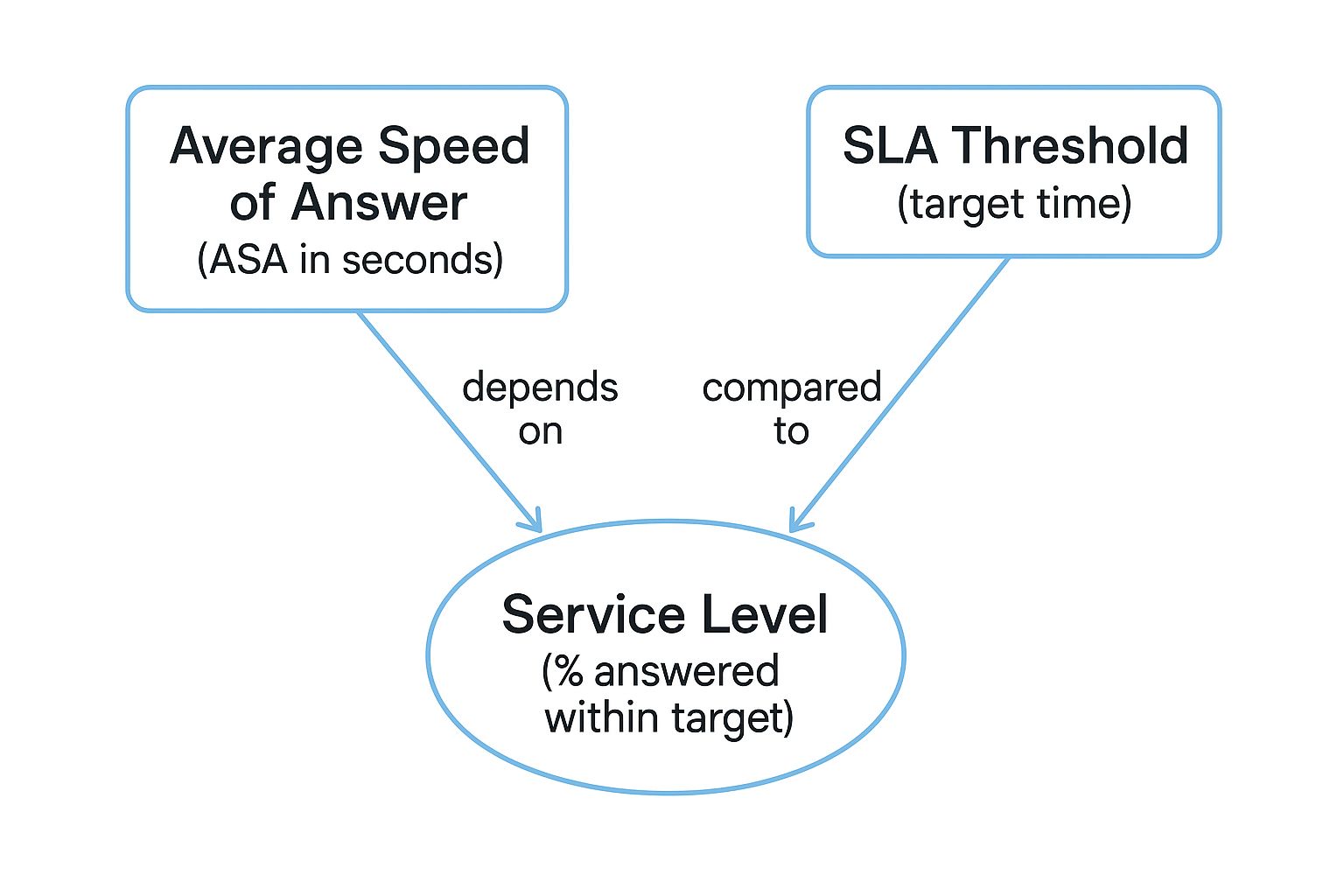
As you can see, the time it takes to answer and the goal you set are the two direct inputs for this critical metric.
First up is your call arrival rate. This is simply the number of calls coming in and the timing of those calls. Just like a morning rush hour, every call center has its own predictable peaks and lulls. Getting a solid grasp of these daily, weekly, or seasonal patterns is the bedrock of smart staffing.
For instance, a new marketing promo or a sudden product glitch can cause a massive traffic jam, overwhelming your team if you weren't prepared for the surge.
Next, you have agent availability—basically, the number of open lanes on your highway. This isn't just about how many people you have on the schedule. It's about how many agents are actually logged in and ready to take a call at any given moment. Things like breaks, team meetings, and after-call wrap-up time all chip away at your real capacity.
A huge piece of this puzzle is schedule adherence. An agent logging in five minutes late might not sound like a big deal, but multiply that across a large team, and those little gaps can seriously damage your ability to keep up with calls and hit your service level targets.
Finally, there's the threshold time. This is your target window for answering a call—the "traffic light" in our analogy. It’s the "20 seconds" you see in the classic 80/20 standard.
Essentially, it's the maximum amount of time a customer should have to wait in the queue before speaking to a live person. This single number sets the entire performance expectation and has a direct impact on how responsive your customers feel you are.
These three components—call volume, agent capacity, and your time target—come together to create the dynamic system that ultimately determines your call center's success.
Figuring out your call center's service level isn't as complicated as you might think. It really just boils down to one simple question: how many calls did we answer quickly versus how many did we get in total?
The standard formula gives you a crystal-clear picture of your team's responsiveness at any given moment.
It looks like this:
Service Level (%) = (Number of Calls Answered Within Threshold / Total Number of Calls Received) x 100
This calculation tells you the exact percentage of calls that hit your speed-to-answer goal.
Let's walk through a real-world example. Say your call center lives by the classic 80/20 rule, aiming to answer 80% of calls within 20 seconds.
During a busy one-hour block, you get 200 inbound calls. Your agents managed to pick up 170 of those calls before that 20-second timer went off.
Here’s how you’d plug those numbers into the formula:
In this case, your service level is 85%. You didn't just meet your goal; you beat it.
Key Takeaway: The time frame you use for measurement is everything. While a daily average is great for a high-level report, seasoned managers watch service levels in 15 or 30-minute intervals. This micro-view helps you pinpoint those specific times—like the post-lunch rush—where performance consistently drops, allowing for smarter staffing tweaks.
Thankfully, most modern call center platforms do all this math for you, splashing real-time service levels across dashboards. But you can always calculate it manually with a simple spreadsheet export from your call logs. If you want to dive deeper into the nuts and bolts, this guide on calculating service level is a fantastic resource.
Getting comfortable with the math behind this core metric is the first step toward making truly data-backed decisions that your customers will notice.
Setting a service level for your call center isn't a one-size-fits-all deal. While the 80/20 rule is a fantastic starting point, the right target really depends on what your customers expect and how urgent their problems are. What’s considered stellar service in retail might be dangerously slow in emergency healthcare.
Think about it like a restaurant. A fast-food drive-thru is all about speed, measuring success in seconds. A fine-dining restaurant, on the other hand, is built around a relaxed, unhurried experience. Both are successful, but their service level expectations couldn't be more different. Your call center is the same—you have to understand your industry's unique rhythm to set goals that are both ambitious and achievable.
In fast-moving industries like technology and retail, speed is everything. Customers usually have time-sensitive questions about products, orders, or technical problems, and their patience can run out fast.
The tech sector, for instance, often sets some pretty aggressive targets. Top-tier tech call centers maintain an average service level of around 79%, meaning they're answering almost four out of five calls within their target window. In retail, where over half of customers grab the phone for urgent issues, the pressure for a quick connection is just as high. This has pushed many in these fields to aim for the classic 80% of calls answered in 20 seconds, with some even striving for a 90/15 goal. You can dive deeper into how different industries are measuring up by checking out these call center statistics.
When you get into sectors like healthcare or finance, the stakes are considerably higher. A slow response to a medical question or a fraudulent charge on a credit card can have far more serious consequences than a delayed package.
Naturally, these industries operate with much stricter service levels.
The following table breaks down how these service level targets compare across different industries and how they correlate with customer satisfaction.
| Industry | Service Level Target | Average Performance | Customer Satisfaction |
|---|---|---|---|
| Technology | 80% in 20-30 sec | ~79% | High, but can drop sharply with long waits |
| Retail/eCommerce | 80% in 20 sec | ~75-80% | Strongly tied to speed and first-call resolution |
| Healthcare | 90% in 30 sec (Non-Emergency) | ~85-90% | Very high, as speed directly impacts patient care |
| Financial Services | 90% in 30 sec | ~88% | High, as security and trust are paramount |
| Emergency Services | 95-100% in <15 sec | ~98% | Critical, directly impacts safety and outcomes |
As you can see, the higher the stakes, the more aggressive the service level target. Industries where a delayed response has minor consequences can afford more flexibility, whereas those dealing with health, safety, or finances must prioritize near-instantaneous connections.
At the end of the day, choosing the right service level is a strategic decision. You have to find the sweet spot between operational costs, customer satisfaction, and the unique demands of your industry. By looking at these benchmarks, you can get a much better sense of where you stand and set targets that truly align with your business goals and, most importantly, your customers' needs.
Artificial intelligence has moved far beyond a trendy talking point. It's now a practical, powerful force for boosting call center service levels. By taking over routine tasks and offering real-time support, AI enables teams to answer calls more quickly, find solutions faster, and cut down on frustrating customer wait times.
Think of an AI-powered chatbot as your digital receptionist. It can immediately field common questions like "What's my order status?" or "How do I reset my password?" This simple act of triage frees up your human agents to pour their energy into the more complex and nuanced conversations that truly require their expertise.
AI's influence goes straight to the heart of agent performance. Picture a generative AI tool working alongside an agent. As a customer explains their problem, the AI listens in and instantly surfaces the exact right information from a vast knowledge base. Those awkward, silent moments while an agent frantically searches for an answer? They become a thing of the past.
This isn't just theory; the results are already here. Companies that have brought generative AI into their customer service workflows have seen a 14% jump in issues resolved per hour and a 9% drop in average handling time. Every second saved is a direct boost to your service level, as it gets your agents ready for the next customer that much faster.
It's predicted that by 2025, a staggering 80% of companies will be using AI-powered chatbots for customer support. This isn't just a trend—it’s a fundamental change in how call centers will manage their queues and hit their service level goals.
The technology is only getting better. Advanced techniques like Retrieval Augmented Generation (RAG) are making call center AI even smarter and more efficient, pushing service levels higher than ever. These aren't just script-following bots; they are systems that truly understand context and can pull the most precise, relevant data in an instant.
By weaving these tools into their operations, call centers can finally shift from being reactive to proactive. It’s no longer just about meeting your service level agreement—it's about consistently blowing past it. The result is a better experience for everyone: the customers who get fast, accurate help and the agents who feel empowered to provide it.
Understanding your current service level is just the beginning. Actually boosting it takes a series of thoughtful tweaks across your team, your processes, and the tools you use.
Imagine your call center as an orchestra. If the strings are playing out of tune, the whole concert falls flat. Your mission is to bring every section into harmony—so customers get fast, accurate, and friendly support. Below, we’ll unpack proven ways to fine-tune your operation and hit your targets without burning out your people.
Staffing is the backbone of any solid service level. Start by looking back at your call history—daily peaks, weekly ebbs, and seasonal swings all matter.
Pro Tip: Even a five-minute delay on an agent login can ripple through your queue. Real-time adherence tracking catches those tiny gaps before they become big problems.
Every second an agent saves on a call means faster service and happier customers. Improving resolution speed doesn’t mean rushing— it means equipping agents to handle issues confidently.
For a deeper dive into coaching and quality audits, check out our guide on mastering quality assurance in call centers.
Putting the right call in front of the right agent makes a world of difference. The goal is fewer transfers, shorter calls, and better first-contact resolution.
When we talk about the service level for call center operations, it’s easy to get lost in the numbers and forget what they really represent. Think of it less as a cold, hard metric and more as a direct line to your company's growth and reputation. Every time a customer connects quickly with a helpful agent, their entire perception of your brand gets a little bit brighter.
That positive first impression creates a powerful ripple effect. Quick answers build trust, reduce frustration, and are fundamental to keeping customers around for the long haul.
Let’s be clear: a poor service level isn't just an operational headache; it’s a financial drain. Recent data shows that a staggering 53% of customers will actually cut their spending with a company after just one negative call center experience. Suddenly, that long hold time isn't just an inconvenience—it's lost revenue walking out the door.
On the other hand, getting it right pays huge dividends. For instance, a high first-call resolution rate—which often goes hand-in-hand with a great service level—makes customers 2.1 times more likely to recommend your brand to others. You can dig into more of these eye-opening trends and their financial impact in recent Qualtrics research.
A high service level isn't just an operational expense; it's a revenue-generating investment. It actively protects your customer base from churning while encouraging repeat business and priceless word-of-mouth marketing.
At the end of the day, a strong service level is the bedrock of a healthy customer satisfaction (CSAT) score. When customers feel like their time is valued and their problems are heard, they stick around. If you're looking for more ways to boost customer happiness, you can explore detailed strategies on how to improve CSAT scores right here on our blog.
Even when you've got a handle on the basics, real-world questions always pop up when you're trying to manage your call center's service level. Think of this as a quick reference guide to tackle those common "what if" scenarios and help you put what you've learned into practice.
You'll hear the 80/20 rule thrown around a lot. It's the classic industry benchmark: aim to answer 80% of calls within 20 seconds.
It’s less of a strict law and more of a widely adopted goal. It strikes a good balance between keeping your operations running smoothly and making sure customers aren't left hanging for too long.
This is a hot topic, and the best answer isn't a simple yes or no. It really depends on when the customer hangs up.
The most important thing here is consistency. Pick a method and stick with it. That's the only way you can track your performance trends accurately over time.
Seeing a sudden nosedive in your service level is stressful, but don't panic. The first step is to play detective and look at your real-time dashboards for the culprit.
Here’s what to check immediately:
Once you know what's happening, you can react fast. Maybe you need to pull agents from other tasks or kick in your overflow plan. Pinpointing the cause is the key to getting your queue back under control.
At Call Criteria, we mix smart AI with real human insight to help you nail metrics like service level. See how our quality assurance solutions can fine-tune your operations and improve every customer conversation at https://callcriteria.com.