

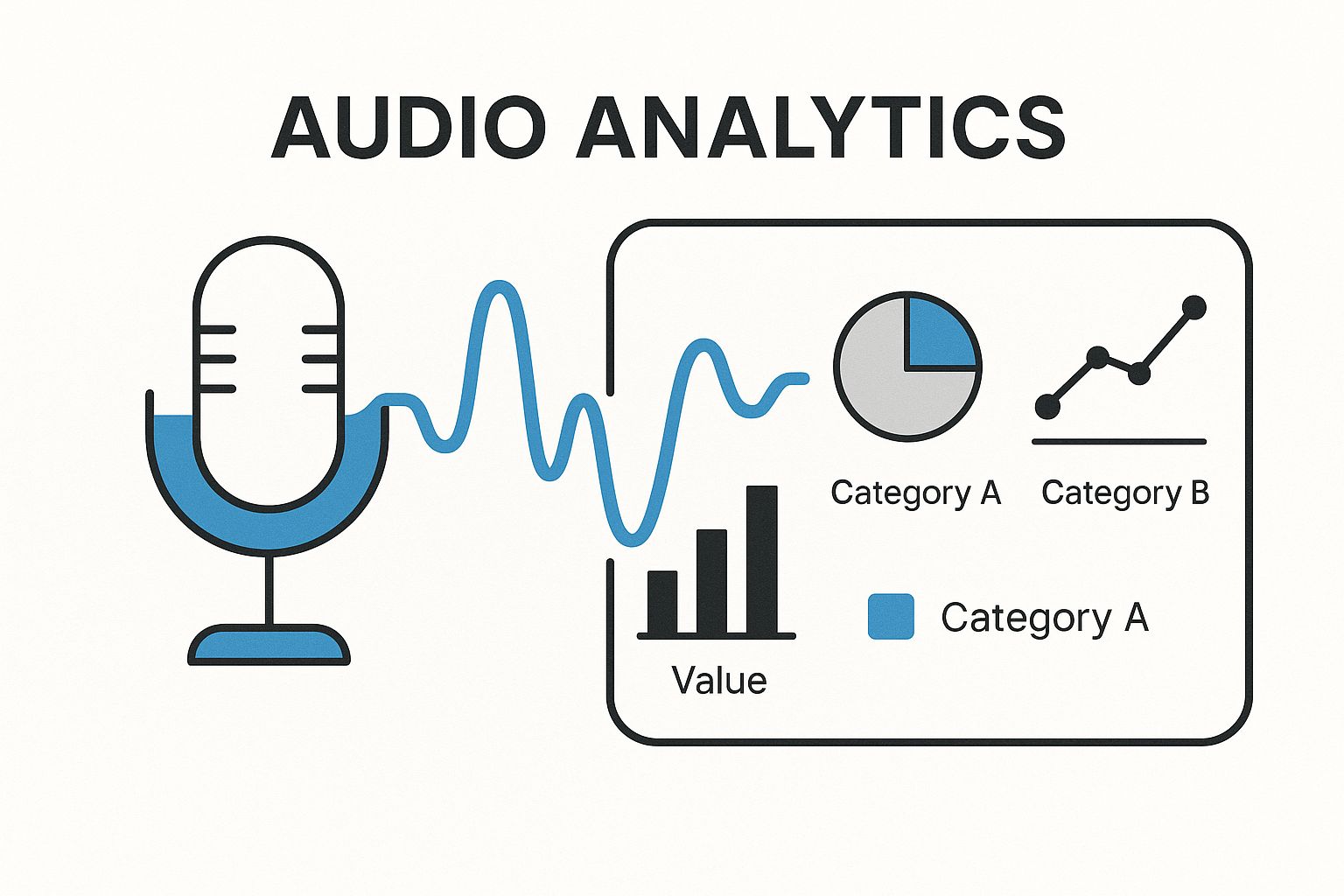
Voice analytics is changing how businesses understand customer interactions. This technology transforms spoken conversations into valuable data, offering insights that improve customer experience and operational efficiency. But how does this technology actually work? It involves understanding the core components enabling voice analytics to interpret the nuances of human conversation.
The power of voice analytics lies in the interplay of several key technologies. Each technology plays an essential role in the process, similar to instruments in an orchestra.
To illustrate the core components and their contribution to voice analytics, consider the table below:
To further illustrate the importance of each component, let's examine them in more detail. The following table explains the essential technological components that power voice analytics systems, their specific functions, and the resulting business benefits they provide.
| Technology Component | Function | Business Benefit |
|---|---|---|
| Speech Recognition | Converts spoken words into text. | Enables analysis of spoken conversations, providing a foundation for understanding customer interactions. |
| Natural Language Processing (NLP) | Analyzes text for meaning, identifies topics, keywords, and intent. | Extracts meaningful insights from customer conversations, enabling businesses to understand customer needs and preferences. |
| Sentiment Analysis | Gauges the emotional tone of the conversation (positive, negative, neutral). | Helps businesses understand customer emotions and improve customer satisfaction. |
| Machine Learning (ML) | Algorithms learn from data, improving the accuracy of other components over time. | Enables continuous improvement and adaptation to different accents, speaking styles, and industry-specific terminology. |
This interconnected system enables voice analytics platforms like Call Criteria to give businesses a complete picture of customer interactions. This translates into tangible benefits, such as pinpointing customer pain points and optimizing agent performance.
The growing demand for voice analytics is reflected in the market's impressive growth. In 2024, the market was valued at approximately $1.3 billion, and projections show it reaching $1.54 billion in 2025. This represents a compound annual growth rate (CAGR) of 18.5%.
Several factors are driving this growth. These include the focus on enhancing customer experience, the increase in remote work, rising cybersecurity concerns, and the integration of voice analytics with other technologies, like conversational AI. By 2029, the market is expected to reach $3.01 billion, maintaining a CAGR of 18.2%. You can find more detailed statistics here: https://www.thebusinessresearchcompany.com/report/voice-analytics-global-market-report
The following data chart visualizes the projected market growth of voice analytics. The chart projects the market's growth from 2024 to 2029, highlighting key data points.
The chart clearly illustrates the projected growth, starting with a $1.3 billion valuation in 2024, increasing to $1.54 billion in 2025, and reaching an anticipated $3.01 billion by 2029. This upward trend underscores the rapid expansion of the market and the increasing importance of voice analytics across various industries. The steep incline emphasizes the potential of this technology and the competitive edge that early adoption can offer.
Voice analytics is more than just interesting technology. It's a powerful tool that drives real business results. This section explores how organizations use voice analytics to generate measurable returns. We'll look at specific applications across several industries and demonstrate how voice analytics transforms operations and boosts profits.
Voice analytics has revolutionized customer service by providing a detailed understanding of customer interactions. For example, analyzing call recordings helps companies identify common customer pain points. Addressing these proactively leads to fewer escalated calls and improved customer satisfaction.
Voice analytics also facilitates real-time agent assistance. By identifying keywords and phrases, the system provides agents with helpful information and resources. This results in faster resolutions and increased first-call resolution rates.
Voice analytics offers significant opportunities for sales improvement. Analyzing successful sales calls helps businesses identify effective communication patterns and replicate them across the sales team. This could involve recognizing phrases or questioning techniques that lead to higher conversion rates.
Furthermore, voice analytics helps personalize sales pitches. By understanding customer preferences and sentiments, businesses can create a personalized sales approach. This targeted approach can significantly resonate with potential buyers.
Voice analytics plays a crucial role in fraud detection and security. Analyzing voice patterns and identifying anomalies allows organizations to detect fraudulent activities more effectively. For example, voice biometrics can verify customer identities and prevent unauthorized access to sensitive information. This is especially important in industries like financial services, where security is paramount.
Beyond customer-facing applications, voice analytics transforms employee training. By analyzing call recordings, training managers can pinpoint areas where agents need additional coaching. This targeted training is more effective than generic programs and ensures agents have the necessary skills and knowledge. The result is a more skilled workforce and improved overall performance.
Voice analytics applications span various industries, each with its unique opportunities. To illustrate these diverse uses, let's examine a table showcasing real-world examples.
This comparison table, "Industry-Specific Voice Analytics Applications", shows how different industries use voice analytics to solve specific business challenges and achieve positive outcomes.
| Industry | Key Applications | Reported Business Outcomes |
|---|---|---|
| Healthcare | Patient risk identification, sentiment analysis of patient feedback | Improved patient care, reduced readmission rates |
| Financial Services | Fraud detection, compliance monitoring | Enhanced security, reduced risk |
| Retail | Personalized marketing, customer sentiment analysis | Increased sales, improved customer loyalty |
| Telecommunications | Agent performance monitoring, call routing optimization | Reduced call handling times, improved customer satisfaction |
As this table reveals, voice analytics offers a powerful way to address industry-specific needs, ultimately driving improvements in key business metrics.
The global voice analytics market is projected to grow significantly, from $3.08 billion in 2024 to $11.98 billion by 2032, with a CAGR of 18.5%. This growth reflects the increasing recognition of voice analytics' value across diverse sectors. Learn more about this market growth here: https://www.skyquestt.com/report/voice-analytics-market
Tracking the right metrics is essential to measure the return on investment (ROI) of voice analytics. Key performance indicators (KPIs) like customer satisfaction scores, conversion rates, average handling time, and first-call resolution rates are vital for assessing the impact of voice analytics. By monitoring these metrics, organizations can demonstrate the value of their investment and identify areas for further optimization. Voice analytics offers valuable insights that improve decision-making across the organization. By understanding customer needs, identifying areas for improvement, and tracking key metrics, businesses can unlock the full potential of voice analytics and drive meaningful results.
Understanding the customer is crucial in today's competitive landscape. Voice analytics offers a powerful way to gain profound insights into customer emotions and experiences. Businesses are using these insights to reshape customer interactions and foster stronger, more meaningful relationships.
This technology analyzes conversations, uncovering hidden emotional cues and unmet needs. This allows businesses to personalize interactions in ways never before possible.
Real-time sentiment analysis is one of the most valuable aspects of voice analytics. During live conversations, the technology can detect subtle changes in customer tone. It can also identify signals of potential frustration. This empowers agents to adapt their approach and address concerns proactively, preventing escalation and improving customer satisfaction.
Automated quality monitoring removes human bias and provides consistent evaluations of agent performance. This data-driven approach helps identify best practices and areas for improvement. Ultimately, this ensures every interaction meets the highest standards.
Voice analytics goes beyond superficial analysis by identifying specific customer pain points. By analyzing conversation content, the technology pinpoints recurring issues and uncovers the root causes of customer frustration.
This information is crucial for product development, service improvements, and targeted marketing campaigns. For example, if analysis reveals frequent complaints about a specific product feature, the company can directly address the issue, leading to greater customer satisfaction and loyalty.
Understanding individual needs and preferences allows businesses to further personalize interactions and offer customized solutions. This personalized touch strengthens customer relationships and fosters brand loyalty.
Voice analytics allows organizations to implement proactive service recovery strategies. By identifying at-risk customers early, businesses can intervene and address concerns before they escalate into major problems. This approach transforms potential detractors into loyal advocates.
Moreover, voice analytics can identify and replicate successful conversation patterns. By analyzing top-performing agents' interactions, businesses can extract key phrases and effective communication styles that lead to positive outcomes. These insights can then be used for training and overall performance improvement.
The voice and speech analytics market was valued at $2.54 billion in 2024 and is projected to reach $3.04 billion in 2025. This growth highlights the increasing demand for customer experience insights across various industries. Learn more about this growing market: Voice and Speech Analytics Global Market Report.
Voice analytics provides a comprehensive understanding of the customer journey, allowing businesses to optimize interactions at every touchpoint. By leveraging these insights, organizations can elevate customer experience, improve operational efficiency, and drive sustainable growth. Platforms like Call Criteria offer robust voice analytics capabilities, empowering businesses to transform their customer interactions.

Transitioning from considering voice analytics to actually implementing it necessitates careful planning. This section provides a practical implementation guide based on the successes of other organizations. We'll explore key aspects such as selecting the right technology, integrating with existing systems, and effectively managing the change.
Start by establishing clear objectives that directly relate to specific business outcomes. For instance, if reducing customer churn is your aim, an objective might be identifying and addressing customer frustration early on. This objective must be measurable.
Next, develop Key Performance Indicators (KPIs) to accurately track progress. For churn reduction, relevant KPIs might include customer satisfaction scores, first-call resolution rates, and the number of escalated calls. These metrics provide tangible proof of voice analytics’ impact.
Selecting the appropriate voice analytics technology is crucial. Consider factors such as call center size, languages used, and the specific insights required. Some solutions focus on real-time analysis, while others specialize in post-call processing. A strategic assessment of your business needs is essential.
Integrating voice analytics with your existing systems, such as your CRM (Salesforce) or helpdesk software (Zendesk), is vital for smooth data flow. This integration allows you to combine voice data with other customer information for a more comprehensive understanding of the customer journey. Evaluating potential compatibility issues and planning for necessary adjustments is important. Think of it as adding a new room to a house – it needs to connect seamlessly with the existing structure.
Prioritizing data privacy is paramount. Ensure your chosen solution complies with regulations like GDPR and CCPA. This includes securely storing voice data, obtaining necessary consent, and anonymizing sensitive information. Transparency with customers about how their data is used is crucial for building trust.
To understand how call centers impact customer experience in the UAE's e-commerce sector, read this article: Elevating Customer Experience in the UAE E-Commerce Sector.
Implementing new technology requires careful change management. Communicate the benefits of voice analytics to all stakeholders, including agents, supervisors, and management. Address their concerns and provide sufficient training.
User adoption is essential. Ensure your team understands how to use the tools effectively. Ongoing support and feedback encouragement foster a culture of continuous improvement.
Anticipate potential obstacles. Data quality problems, like background noise or subpar recordings, can impact accuracy. Integration challenges with older systems might require custom development. User resistance to new processes can also hinder adoption.
However, proactive solutions mitigate these challenges. Tools like Call Criteria often improve audio quality and integrate seamlessly with existing platforms. Effective training and communication can overcome user resistance.
Develop a realistic budget that encompasses software licenses, implementation costs, and ongoing maintenance. Establish clear timelines for each phase. Initiate a pilot program to test and refine your approach before scaling across the entire organization. This iterative process ensures a smoother rollout.
By adhering to this roadmap, you can effectively implement voice analytics and transform your call center into a data-driven powerhouse. This will improve customer experience, enhance agent performance, and ultimately drive business growth.
Implementing voice analytics offers significant advantages, but it also comes with its own set of challenges. Successfully addressing these hurdles is essential to harnessing the full power of this technology. This section explores some common obstacles and offers practical, experience-based solutions.
Data privacy is a paramount concern with voice analytics. Regulations like GDPR and CCPA mandate strict guidelines for handling personal data. Organizations must prioritize secure data storage, anonymization techniques, and transparent consent procedures.
Fortunately, proven methods exist to balance these regulatory requirements with the need for valuable analytical insights. For instance, anonymizing sensitive information before analysis allows for trend identification without compromising individual privacy.
Achieving accuracy in diverse linguistic environments can be a significant challenge. Accents, dialects, and multiple languages can impact the accuracy of speech recognition and sentiment analysis.
However, advanced techniques can improve accuracy in multilingual settings. These include using language-specific models and incorporating machine learning that adapts to diverse speech patterns.
Integrating voice analytics with existing systems can be complex. Many organizations have legacy systems that are not readily compatible with newer technologies.
Careful planning and strategic integration processes, however, can minimize disruption. This could involve phased rollouts or using APIs to bridge the gap between systems. Much like a home addition requires careful planning to ensure a seamless fit, integrating voice analytics demands a considered approach.
Voice data generates enormous amounts of information. Effectively managing these large data volumes and ensuring real-time processing is critical. This often necessitates robust data storage solutions and efficient data processing algorithms. Finding specific information within this massive dataset is like searching for a single grain of sand on a beach; efficient data management provides the tools to quickly isolate what you need.
Meeting customer expectations for real-time feedback and insights requires systems capable of rapid and efficient data processing. This allows for immediate action based on the insights gained.
Poor audio quality can significantly impact the accuracy of voice analytics. Background noise, low recording volume, and network issues can distort speech and hinder analysis. Organizations need strategies to address these audio quality concerns.
Using noise reduction algorithms, for example, can enhance the clarity of recordings and improve analytical accuracy. Additionally, optimizing recording equipment and network connections can minimize quality issues at the source.
Implementing voice analytics successfully requires more than just technical expertise. It also demands effective change management. User resistance, inadequate training, and unclear communication can impede adoption.
To foster enthusiasm and maximize value, organizations must communicate the benefits clearly, provide sufficient training, and incorporate user feedback into the implementation process. This ensures that the entire organization embraces the new technology and its potential. Just as introducing a new tool to a team requires proper training and communication, successful voice analytics adoption hinges on these factors.
By proactively addressing these challenges, organizations can confidently implement voice analytics solutions, unlocking valuable insights, improving customer experience, and driving significant business benefits. Tools like Call Criteria are designed to address these challenges, providing businesses with the functionality and support they need to succeed with voice analytics.
Voice analytics is constantly changing, and new innovations are poised to reshape how businesses operate. This section explores emerging trends, like emotion AI, conversational intelligence, and predictive analytics, which are pushing the boundaries of voice analytics. We'll also examine how voice analytics integrates with other technologies, creating exciting new possibilities.
Emotion AI goes beyond simply identifying positive, negative, or neutral sentiment. It delves deeper into the nuances of human emotion. This technology can detect subtle cues like frustration, excitement, or hesitation in a speaker's voice. For example, a slight tremor could indicate nervousness, while a change in pace might suggest impatience.
This granular understanding of emotion allows businesses to tailor responses with greater precision. Imagine a customer service agent receiving real-time alerts about a customer's rising frustration. This allows the agent to adjust their approach and prevent a negative experience, enhancing customer satisfaction and building stronger relationships.
Conversational intelligence platforms elevate agent coaching. These platforms analyze conversations to identify areas where agents excel and where they need improvement. They can even provide real-time guidance during calls, suggesting optimal responses or offering helpful resources.
It's like having a virtual coach constantly monitoring and providing feedback. This leads to more effective communication and improved performance. This targeted training approach ensures agents have the skills to handle complex customer interactions.
Predictive analytics uses voice data to anticipate future customer behavior. By identifying patterns and trends in past conversations, businesses can proactively address potential issues. For example, if analysis reveals that customers mentioning a specific product feature are likely to churn, the business can proactively reach out and offer support or incentives.
This ability to anticipate needs strengthens customer relationships and increases retention. It’s like having insights into future customer actions, empowering businesses to stay ahead of the curve.
Voice analytics is increasingly converging with other technologies, opening up entirely new interaction possibilities. Integrating with Augmented Reality (AR) could allow service technicians to receive real-time voice instructions overlaid onto their field of view, enhancing efficiency and accuracy.
Pairing with virtual assistants enables customers to interact with businesses using natural language, creating more intuitive and personalized experiences. Connecting with Internet of Things (IoT) devices allows for voice control and automation in smart homes and other connected environments. This creates a richer and more immersive user experience.
These advancements are reshaping customer expectations and how we think about privacy. As voice analytics becomes more sophisticated, customers will expect personalized, proactive service. This requires businesses to adapt and adopt new technologies to meet these demands.
At the same time, organizations must address growing privacy concerns. Transparency and data security are paramount for maintaining customer trust. Balancing personalization and privacy will be essential for future success. The future of voice analytics is bright, with the most transformative applications yet to come. Early adopters of these emerging technologies will gain significant competitive advantages.
Ready to transform your call center with the power of voice analytics? Learn more about Call Criteria and how it can improve your customer interactions: Call Criteria